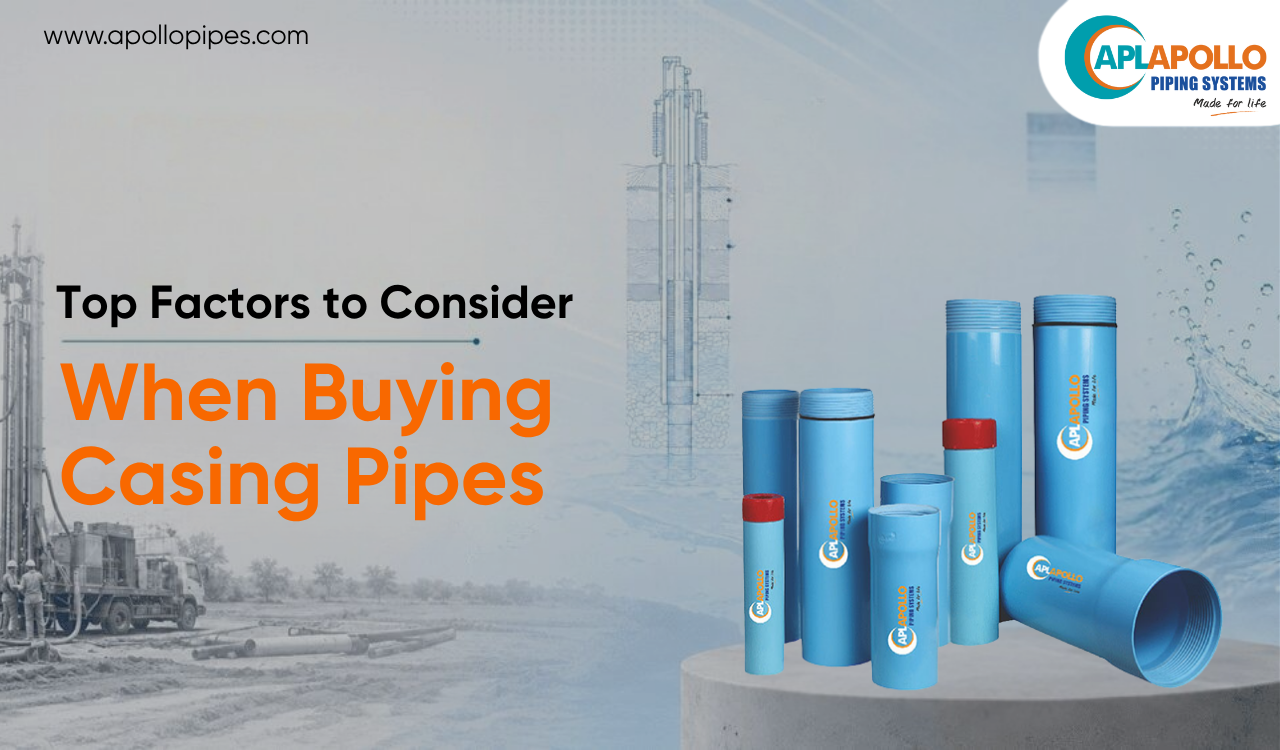
Casing pipes are an important part of borewell construction because they provide structural support to the drilled well and help protect the groundwater pathway from surrounding soil, gravel and other foreign particles. The right casing pipe can contribute to a properly designed and durable borewell system. However, choosing casing pipes should involve more than comparing prices. Material, diameter, strength, pipe type, applicable standards, installation requirements and intended use all need to be considered.
What are casing pipes?
Casing pipes are pipes installed inside a drilled borehole to provide support and protection to the well structure. Depending on the borewell design, they may be used as plain casing or as slotted/screen sections to allow groundwater to enter while helping restrict unwanted material from entering the well.
Top Factors to Consider When Buying Casing Pipes
When selecting casing pipes, consider these key factors:
1. Material and product quality
2. Pipe size and diameter
3. Pressure and load-bearing strength
4. Plain or slotted casing type
5. Applicable standards and specifications
6. Corrosion and chemical resistance
7. Installation and jointing requirements
8. Intended application
9. Durability and lifecycle value
10. Manufacturer support and availability
1. Material and Quality
The material directly affects the casing's strength, durability and resistance to the conditions around a borewell. Groundwater environments can expose pipes to moisture, dissolved chemicals and other factors, so material selection matters.
uPVC casing pipes are commonly considered for borewell applications because uPVC offers useful characteristics such as resistance to corrosion and chemicals, along with relatively low weight compared with conventional metal alternatives. The material should always be selected according to the borewell design and operating conditions.
2. Pipe Size and Diameter
Correct sizing is essential for borewell casing. Buyers should consider both the inner diameter and outer diameter, along with the borehole dimensions and the dimensions of the carrier pipe or pumping arrangement.
The casing pipe should provide sufficient internal clearance for the equipment and pipework used inside it. Before purchasing, confirm the required casing pipe size with the drilling contractor or project engineer rather than selecting a diameter based only on availability.
3. Pressure and Load-Bearing Strength
A casing pipe must withstand the conditions surrounding the borewell. In deeper borewells, the weight of surrounding soil can place considerable pressure on the casing structure.
Therefore, evaluate the pipe's structural strength and suitability for the planned depth. The required specification can vary depending on borewell depth, geological conditions and installation method.
4. Type of Casing Pipe
Casing pipes are generally available in different configurations for different borewell requirements.
Plain casing pipes provide continuous pipe walls and are generally used where the casing's primary function is structural support and protection.
Slotted or screen pipes have openings that allow groundwater to enter the well while helping control the movement of surrounding formation material. The choice between plain casing, slotted casing and screen sections should be based on the borewell design and geological conditions.
5. Standard Compliance and Product Specifications
Before purchasing, check the applicable Indian Standard, product dimensions and manufacturer's technical specifications. Standards help establish requirements related to the product's construction and dimensions.
For products manufactured to IS 12818, buyers should verify that the product documentation and markings correspond to the applicable requirements. It is also useful to check available technical literature, dimensions and other product information before placing an order.
6. Corrosion and Chemical Resistance
Borewell casing remains exposed to groundwater and surrounding conditions for long periods. Corrosion resistance can therefore be an important consideration, particularly when comparing different materials.
uPVC is naturally resistant to corrosion and can also offer chemical resistance. Metal pipes, depending on the material and environment, may require different considerations regarding corrosion. The choice should be based on the actual groundwater and site conditions.
7. Installation and Jointing
Consider how easily the casing pipes can be transported, handled, installed and joined at the site. Pipe weight can influence handling requirements, while the jointing method can affect installation time and labour requirements.
For large or deep borewell projects, discussing installation procedures with the drilling contractor before purchasing can help ensure that the selected pipes are compatible with the planned method.
8. Application and Intended Use
The right casing pipe depends on where it will be used. Requirements can differ between a domestic borewell and an irrigation, industrial or mining borewell.
Rainwater-harvesting projects may also require specific casing and screen arrangements. Understanding the groundwater conditions, well design and intended use helps buyers select an appropriate product rather than relying on a generic casing pipe size.
9. Durability and Long-Term Value
The lowest initial purchase price does not necessarily represent the lowest overall project cost. Buyers should consider expected service conditions, handling, installation, maintenance requirements and product durability.
A casing system that is appropriate for the application can help avoid problems associated with unsuitable dimensions, inadequate strength or difficult installation. Looking at lifecycle value provides a more useful basis for comparison than upfront cost alone.
10. Manufacturer Reputation and Product Support
Finally, consider the manufacturer's track record, product consistency, technical documentation, availability and support. Established product information can make it easier for engineers, contractors and buyers to verify specifications before installation.
For borewell projects, access to appropriate technical information and product availability can also simplify procurement and replacement requirements.
APL Apollo Casing Pipes
APL Apollo offers Casing Pipes for borewell applications, with its range including plain casing pipes and screen/slotted pipes. These pipes are intended for protecting domestic, irrigation, industrial and mining borewells and are also suitable for rainwater-harvesting applications. The pipes help keep gravel pack and foreign particles out of the borewell water.
These Casing Pipes are lighter weight than conventional metal pipes, ease of transportation, fast and easy jointing, chemical resistance, corrosion resistance, bacteria resistance, non-conductive characteristics and lifecycle longevity. These characteristics can be relevant when evaluating handling, installation and long-term use requirements for a borewell casing system.
These Well Casing Pipes are available in diametric sizes from 35 mm to 350 mm. We builds uPVC plain casing pipes and casing slotted pipes as per IS 12818, along with a range of ribbed screen pipes as per IS 12818. The listed ribbed screen pipe sizes include 50 mm, 100 mm, 125 mm, 150 mm and 200 mm nominal diameters.
For buyers comparing casing pipes for borewell applications, the product range provides options for different borewell designs while giving engineers and drilling contractors specified dimensions and product information to evaluate against project requirements.
Frequently Asked Questions About Casing Pipes
1. What are casing pipes used for?
Casing pipes are used in borewells to support the drilled well structure and help protect the well from surrounding soil, gravel and foreign particles. Depending on the design, plain and slotted or screen pipes can serve different functions within the borewell.
2. How do I choose the right casing pipe size?
Select the size according to the borehole dimensions, well design and internal carrier pipe or equipment requirements. Check both inner and outer diameters and confirm the required dimensions with the drilling contractor or engineer before purchase.
3. What is the difference between plain and slotted casing pipes?
Plain casing pipes have a continuous wall, while slotted casing pipes contain openings designed to permit groundwater entry. The appropriate arrangement depends on the borewell design, surrounding formation and groundwater conditions.
4. Are uPVC casing pipes suitable for borewells?
uPVC is used for borewell casing because it can provide characteristics such as corrosion and chemical resistance while being relatively lightweight compared with conventional metal pipes. Suitability still depends on the specific borewell design and installation conditions.
5. Why is IS 12818 important for casing pipes?
IS 12818 is an Indian Standard associated with thermoplastics pipes for use as casing or screen pipes in tubewells. Checking applicable standard compliance helps buyers assess whether the product meets the relevant technical requirements.
6. What should I check before buying borewell casing pipes?
Check the material, diameter, strength, pipe type, applicable standards, technical specifications, installation and jointing requirements, intended application, availability and manufacturer support. These factors help ensure that the selected casing is appropriate for the project.